



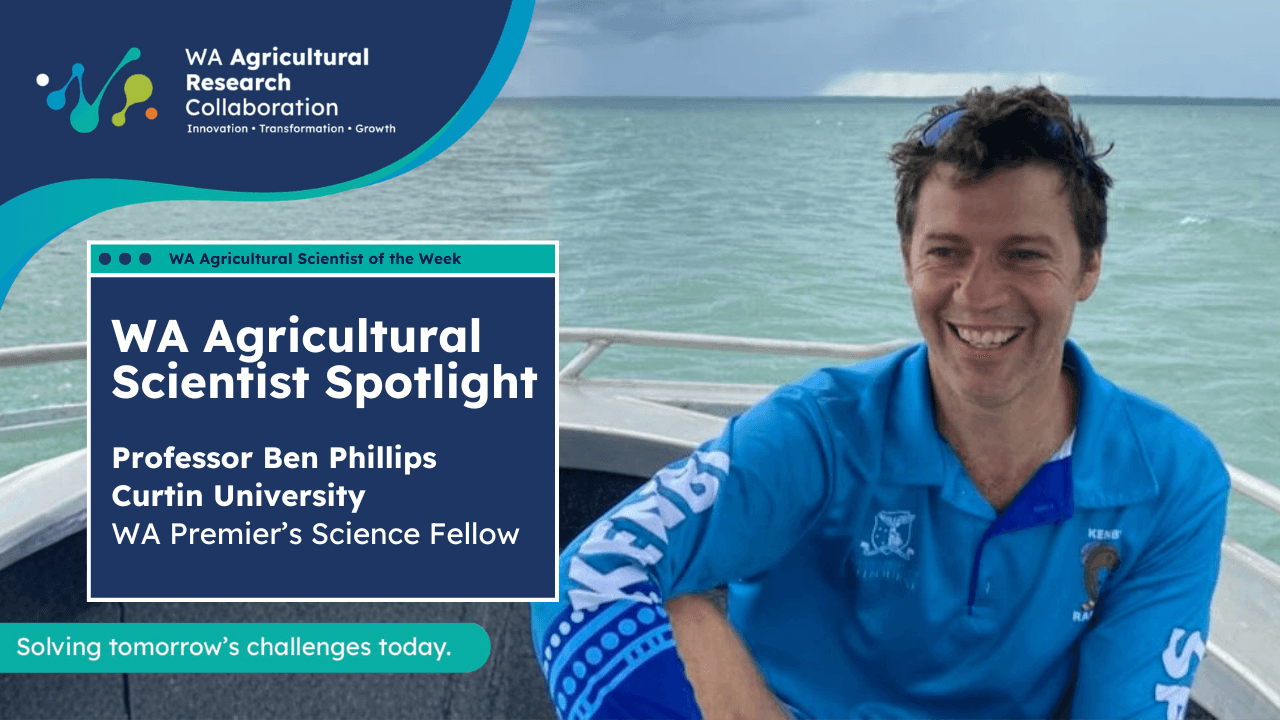
Every fortnight, the WA Agricultural Research Collaboration (WAARC) profiles one of Western Australia’s leading scientists whose curiosity, expertise and commitment are shaping the future of agriculture.
This series dives into the career journeys, inspirations and research driving our state’s most innovative thinkers, highlighting how their work contributes to more resilient, productive and sustainable agricultural systems.
This edition features Professor Ben Phillips, a WA Premier’s Science Fellow at Curtin University, whose expertise in ecology and evolutionary biology sits at the crossroads of some of agriculture’s most pressing challenges – from invasive species to the movement of genes across landscapes.
From tractors and cattle to the world of scientific discovery
Prof Phillips’ connection to the land began long before his scientific career took shape.
With farmers in the family, he spent school holidays on horseback, mustering cattle, and learning the rhythms of rural life.
“My mum’s side of the family ran cattle, so I grew up riding horses and mustering cattle on the school holidays,” he said.
“I drove tractors years before I drove a car and I’m comfortable on farms, but it never really occurred to me to do agricultural science.”
Despite this early exposure, it was curiosity that eventually guided his academic direction.
His university journey began with an unexpected combination of interests.
“I started out thinking I would like to do law and science,” Prof Phillips said.
“Turns out I didn’t really like law, but science was great, so away I went.”
This shift led him to an undergraduate degree at The University of Queensland.
Then, during his Honours year, he discovered the kind of work that would become central to his career.
“I undertook a research project for my Honours year and was immediately hooked on research,” he said.
“I fell in love with the discovery process and setting out to know things that no-one yet knows.”
That spark propelled him into a PhD at The University of Sydney, then onward through a succession of postdoctoral roles, research fellowships and academic positions at James Cook University and The University of Melbourne.
In 2023, he moved across the continent to take up the Western Australian Premier’s Science Fellowship.
Prof Phillips identifies as a generalist whose work spans ecology, evolution and statistics.
“I’m not really an agricultural scientist,” he said.
“I work on ecology and evolution, and these have quite a few obvious applications to agriculture.”
His focus on agricultural problems stems from this broader theoretical base, with his interest being how he can bring theory and tools from ecology, evolution, and statistics to bear on real-world problems.
However, Prof Phillips remains open to how his career might continue to evolve.
“I haven’t had a career in agricultural science,” he said.
“But it may happen yet, you never know.”
Building biosecurity capability for Western Australia
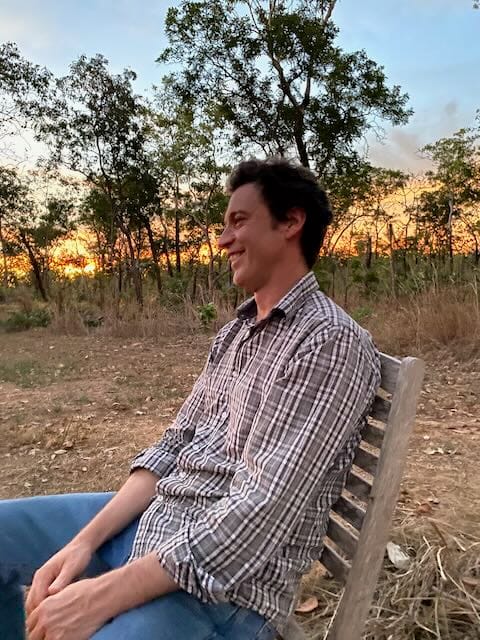
Today, as a WA Premier’s Science Fellow, Prof Phillips leads a multidisciplinary team focused on strengthening Western Australia’s biosecurity analytics – a capability central to protecting agriculture, the environment and communities.
His team of 10-14 people spans students to research fellows, and together they work across projects ranging from field surveillance to genetic modelling.
His day-to-day work reflects this diversity.
“I’m not really sure there is a typical day,” Prof Phillips said.
“It can range from helping students with problems, through to advocating for regulatory and legislative change, or to heading bush with Indigenous rangers to go look for invasive species.”
Prof Phillips’ research portfolio is intentionally broad, spanning polyphagous shot-hole borers, millipedes, mosquitos, salmon lice, cane toads, and quolls.
However, the common thread is an interest in movement across landscapes and seascapes.
“Our work is all over the place, to be honest,” he said.
“All sorts of questions, but a sizable chunk of it is about how populations (and their genes) move about through space.”
His expertise in the ecology and evolution of invasive populations arose through practical need rather than deliberate specialisation.
But it was the complexity revealed through studying invasions that continues to draw him in.
“When you lift the lid on invasions there is a fascinating, beautiful, and complex thing going on, and I always want to know more,” he said.
Understanding the movement of organisms and genes is a critical component of agricultural resilience.
The spread of pests, diseases or resistance traits can have significant economic and environmental consequences.
“One of the useful things we work on is how best to eradicate, or contain, invasions,” Prof Phillips said.
“This has obvious applicability to new pest species but also applies to the spread of invasive genes like, for example, the spread of pesticide resistance.”
He emphasises that movement is often the most difficult aspect of a system to measure yet it is central to effective management.
“Understanding the movement of plants and animals (and their genes) is a real logistical challenge, but it is also often the key to successful management,” he said.
His team also focuses on developing new ways to measure movement, expanding the tools available to industry and regulators.
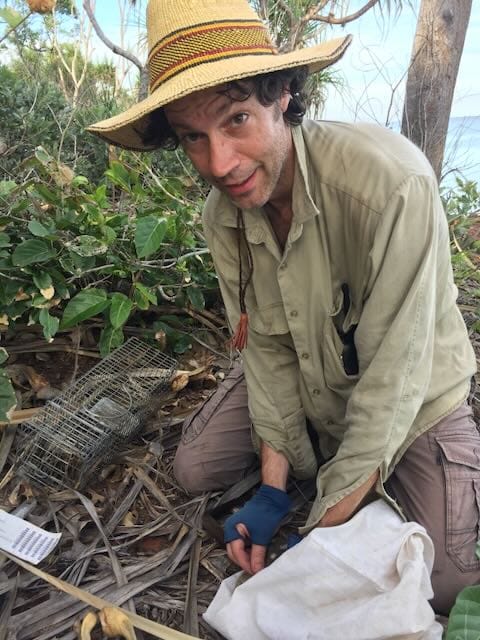
It was Prof Phillips’ knowledge of invasive species that made him the perfect candidate to lead one of WAARC’s three polyphagous shot-hole borer projects.
The Curtin University project – Decision Support Tools for Managing Polyphagous Shot-hole Borer – aims to develop predictive models and risk maps to help prioritise surveillance and control efforts, ensuring efficient resource allocation, and enhanced decision-making.
The methodologies and tools developed through the project will be adaptable to other biosecurity challenges.
Ultimately, the project will strengthen WA’s biosecurity expertise in modelling and epidemiology, ensuring lasting benefits for the state’s capability to respond to future pest threats.
A scientific achievement with global relevance
Among Prof Phillips’ career accomplishments, one stands out for both its conceptual significance and its broad applicability.
He was one of the scientists behind unearthing and describing a poorly understood evolutionary process, one that is now called spatial sorting.
“It is a fairly nerdy thing,” he said.
“It is basically natural selection but operating through space rather than time.
“Spatial sorting is one of the ultimate reasons that plants and animals disperse to new locations, so it’s fairly important as it turns out.”
It is also something that helps explain why invasion tends to accelerate over time, and why tumours metastasise.
However, Prof Phillips also describes a shift in what he finds rewarding about scientific work, and it’s certainly changed over the years.
Where discovery once motivated him, he now finds greater satisfaction in enabling others to succeed.
“Nowadays it is mentoring, supporting, and creating opportunities for younger scientists, and in seeing scientific ideas translated into practice,” Prof Phillips said.
For students and early-career researchers, Prof Phillips offers a simple but evidence-backed piece of advice.
“It is wonderfully cliched, but there is evidence behind it: follow your passion,” he said.
“People who do something because they love it tend to spend a lot more time doing that thing than the average person, and as a consequence, they get very good at that thing.
“Passion is an excellent way to grow expertise.”
As agriculture faces increasing challenges – from emerging pests to climate-driven shifts in species movement – the work of scientists like Prof Phillips becomes ever more vital.
His research on the movement of organisms, genes and populations offers pathways for industries to anticipate risk rather than simply respond to it.
Although he may not describe himself as an agricultural scientist, his contributions sit close to the heart of Western Australia’s agricultural future.
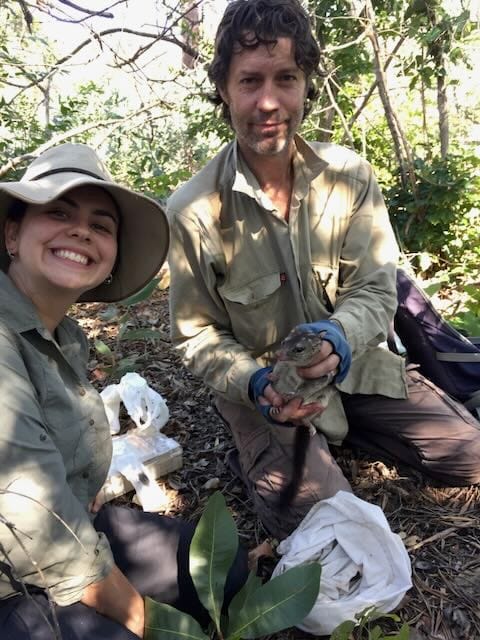
Through the WA Agricultural Scientist Spotlight series, WAARC celebrates the contributions of researchers like Ben Phillips, whose work exemplifies the dedication and innovation needed to advance agricultural science in Western Australia.
By sharing their stories, the series aims to inspire a new generation to pursue careers in this vital field, ensuring the State remains at the forefront of agricultural research and sustainability.